
The complete guide
Choosing a Play House Tent That Children Actually Use
The corner of the room problem
Children claim space. Give them a free afternoon and they will build something out of cushions, blankets and whatever chairs they can drag. Then it collapses, or someone needs the chairs back, and the whole thing has to be rebuilt tomorrow.
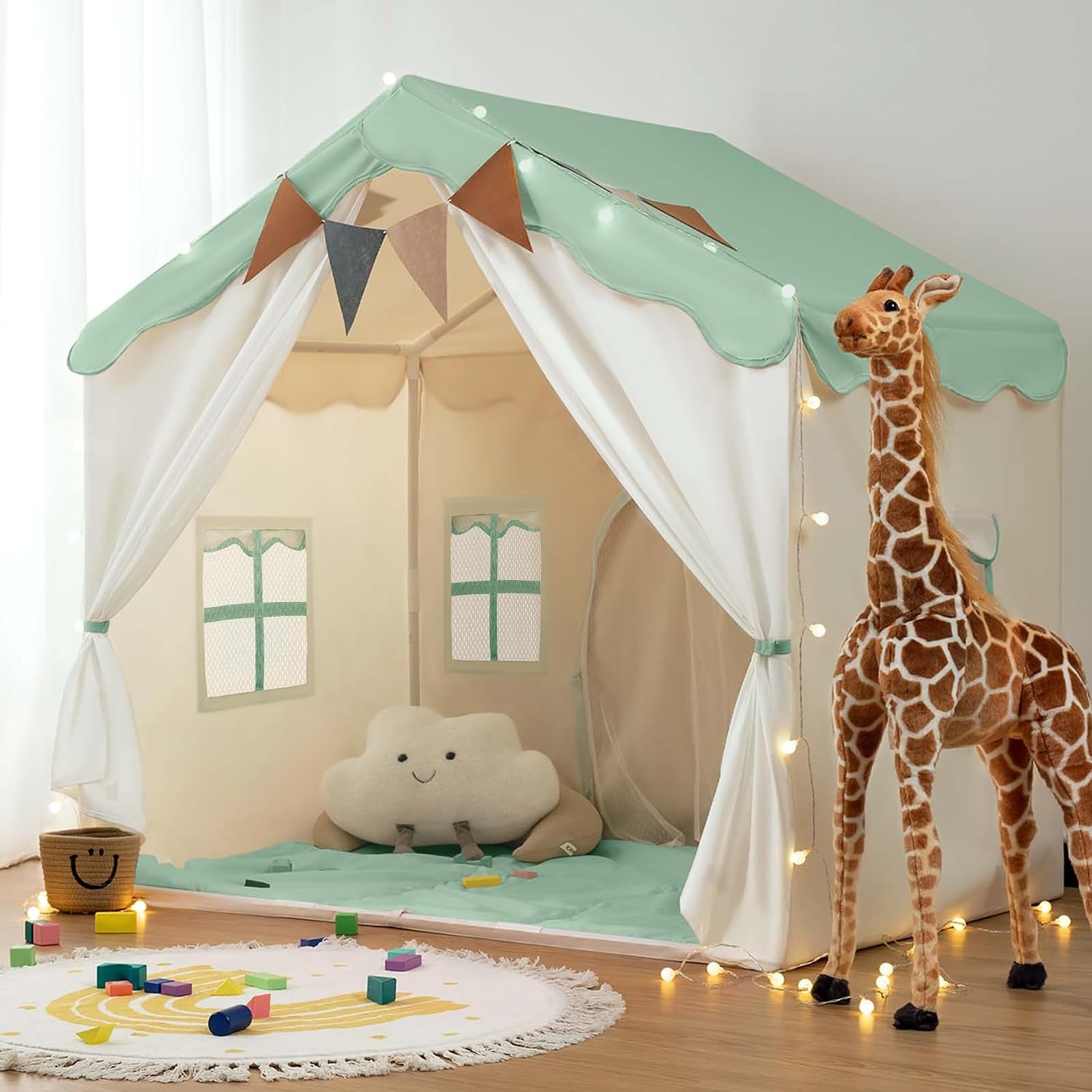
A play house tent solves that in a fairly ordinary way. It is a frame with a cover over it. But the effect on a child is not ordinary. It gives them somewhere with walls and a door that belongs to them, inside a house where almost nothing else does. That is why these tents hold a child's attention long after flashier toys have gone quiet in a cupboard.
The practical question for parents is different. Will it fit, will it last, and will it be a pain to put up. Those three answers decide whether a kids playhouse tent becomes a daily fixture or a half-collapsed heap behind the door.
How a frame tent actually works
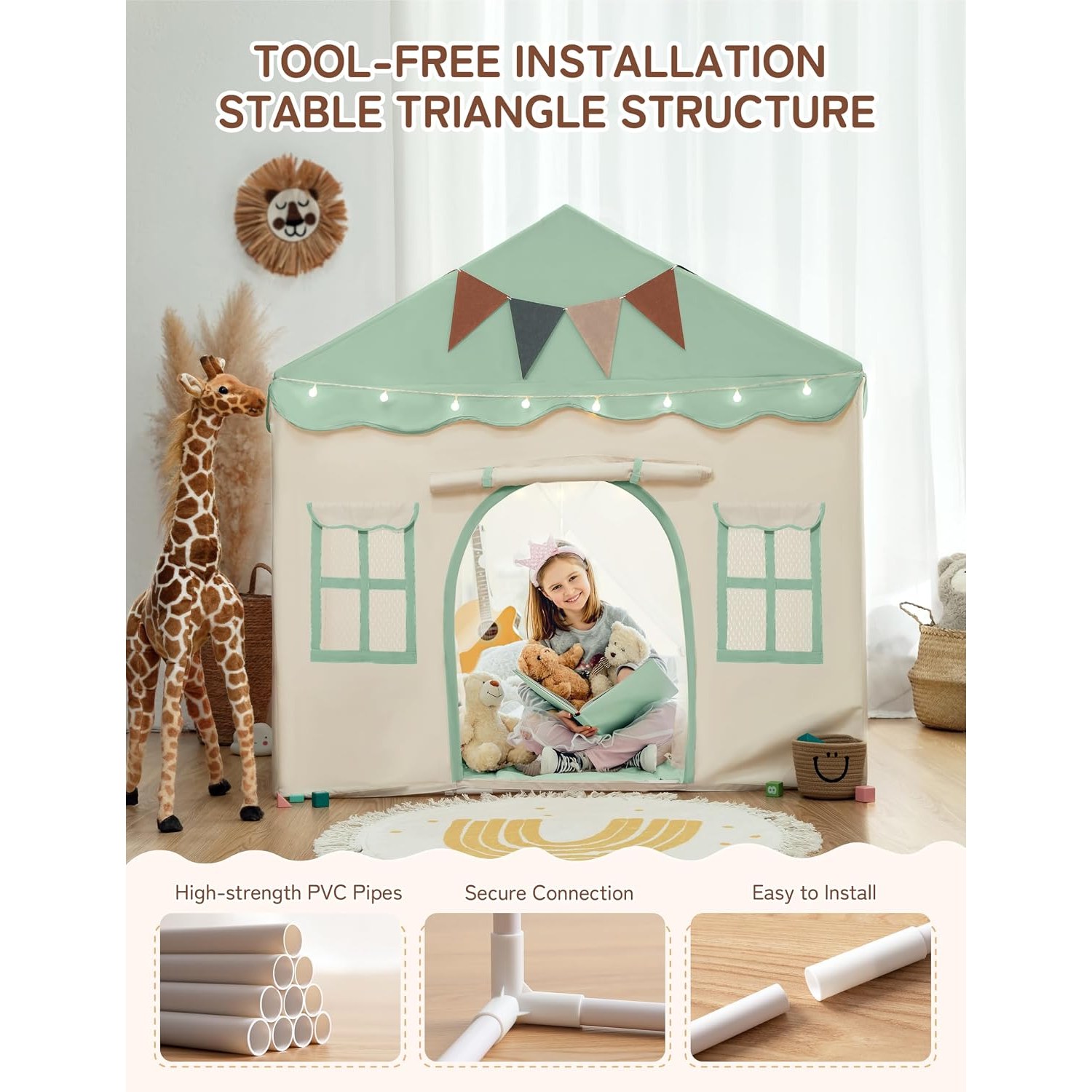
This one uses fibreglass poles that push together into a frame, with a polyester cover pulled over the top. There are no pegs, no guy ropes and no tools. You build the skeleton, slide the fabric on, and that is it.
Fibreglass is a sensible pole material for indoor use. It is light, it bends under pressure instead of snapping, and it does not rust if the tent gets a bit damp. The trade-off is that fibreglass poles need to be fully seated at every joint. If one is only half pushed in, the frame sits slightly short and the cover hangs loose. People often assume they have been sent the wrong size cover when really a single pole has not clicked home.
So when you build it, go around the whole frame and press each connection firmly. Then fit the cover. If anything sags, check the joints again before you worry about anything else.
The cover itself is polyester, which is the usual fabric for a childrens play tent with mat. It takes dye well, which is why these tents come in strong colours, and it can go in a washing machine when something inevitably gets spilled inside.
Why two doors change the play
Most play tents have one opening. That sounds fine until you watch three children try to use it. One blocks the doorway, one tries to get past, and the game stops while they sort it out.
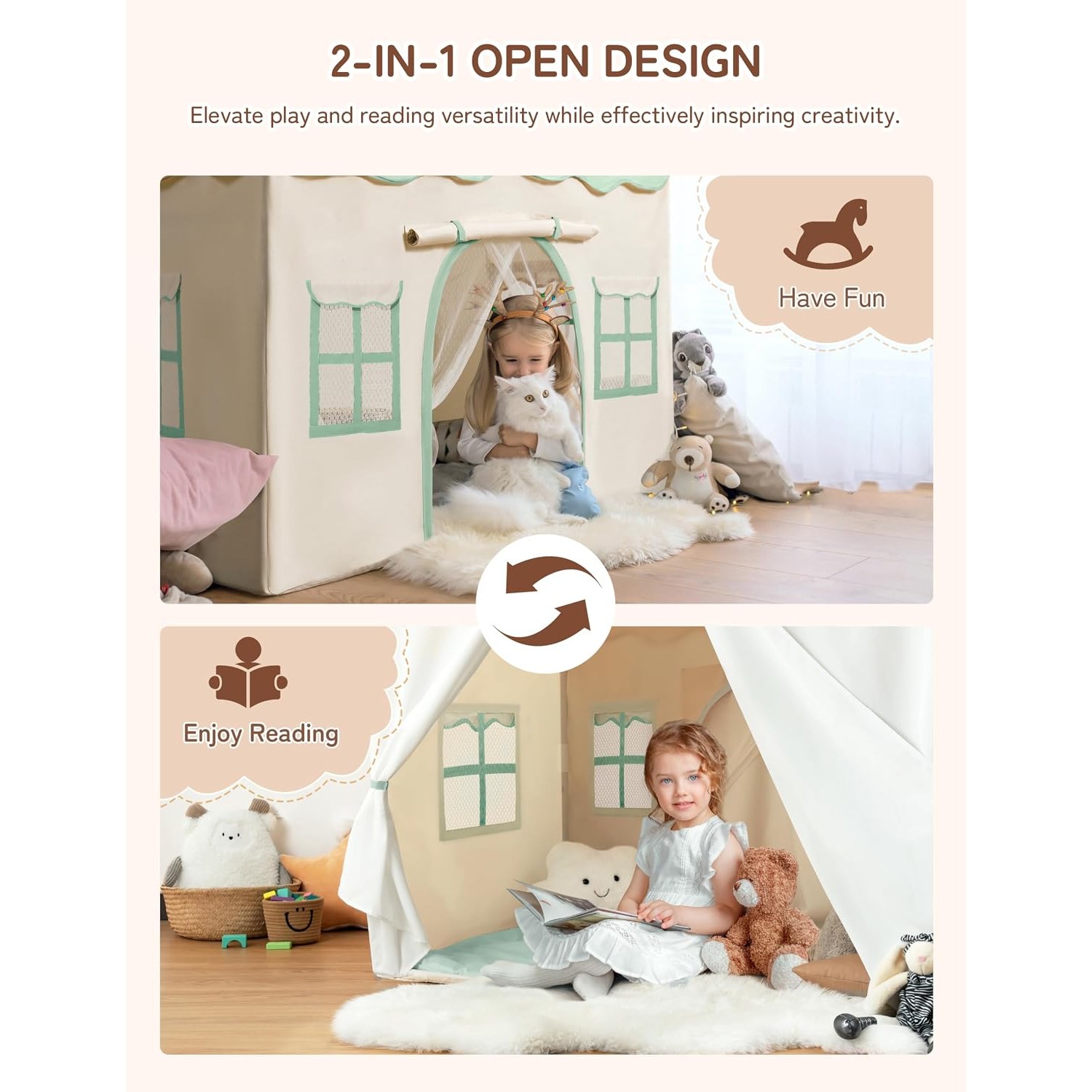
Two doors, one at the front and one at the back, turn the tent into a through-route. Children run loops. They hand things through. They invent a shop with a door for customers and a door for staff, or a train with an entrance and an exit. The space becomes part of the game rather than just a container for it.
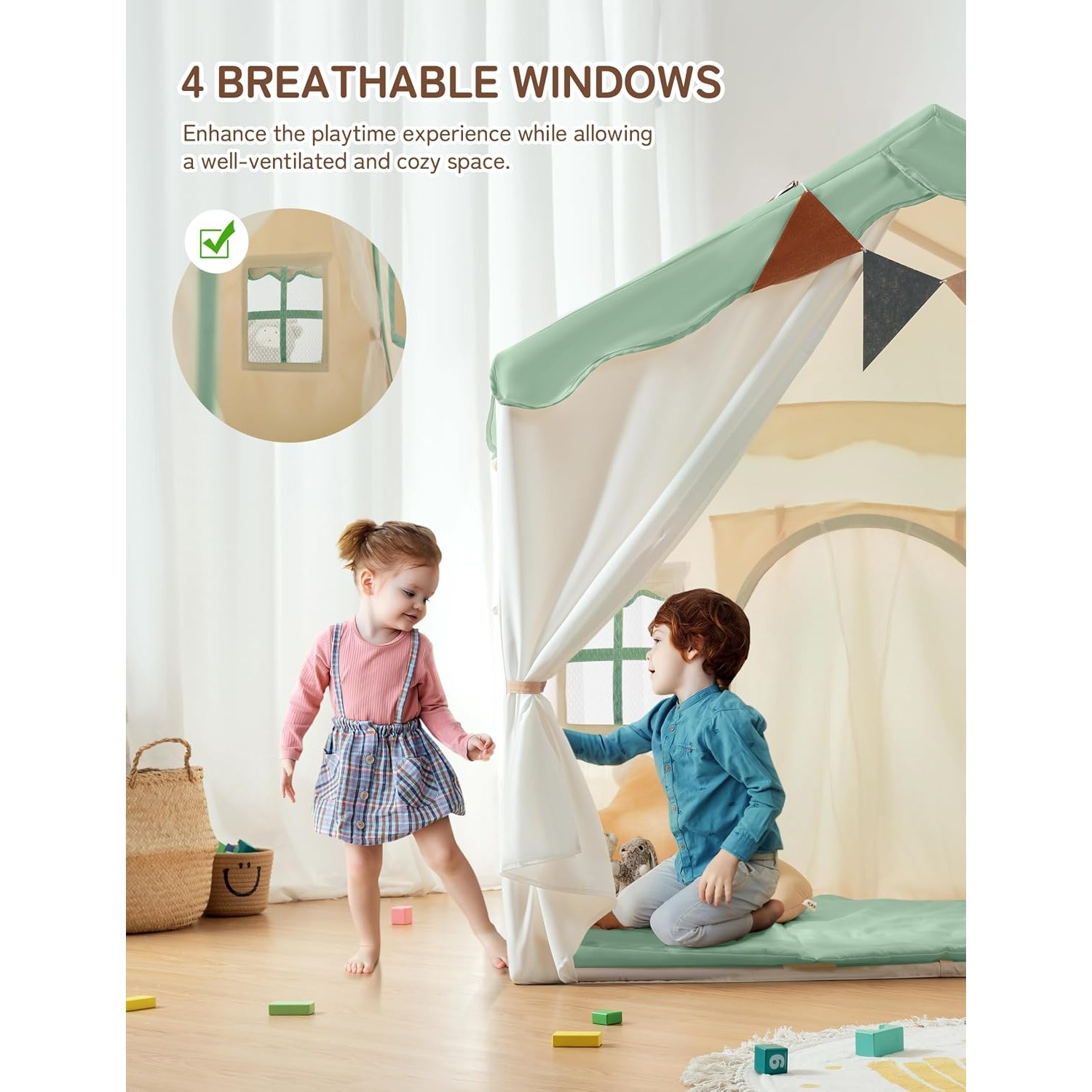
There is a parenting benefit too. A second opening means you can always see in from somewhere in the room without crouching at a single doorway. Add the four windows, which roll up and fasten open, and you can keep an eye on things from the sofa.
Those windows do a second job. A sealed fabric box gets warm and stuffy fast, especially with a couple of children inside. Rolling up the window curtains lets air pass straight through. Roll them down again and the tent dims, which suits a child who wants a quiet corner rather than a racetrack.
The mat matters more than you think
Plenty of tents are sold as a shell only. You get the frame and the cover, and the floor is whatever your floor already is. On carpet that is tolerable. On boards or tiles it is cold and hard, and children stop lying down in it.
This set includes a padded mat that drops into the base. Two things follow. First, children stay in it longer, because lying on the floor with a book is suddenly comfortable. Second, the non-slip backing stops the whole tent creeping across smooth flooring every time someone dives in.
If you want it to become a reading nook rather than just a place to hide, the mat is the part that makes it happen. Add a cushion and a small basket of books and you have a decent quiet corner for an older child.
Working out whether it fits
The footprint is 130 cm wide by 90 cm deep, and it stands 130 cm high. Before you order, get a tape measure out and mark that rectangle on the floor with masking tape. Live with it for an evening.
A few things to check while that tape is down. Can both doors actually open, or will one face a wall? Is there a radiator, heater or plug socket within reach of the fabric? Does it block a door, a drawer or a route to the bed? Is there ceiling clearance at 130 cm, which matters under a sloped attic roof or a bunk?
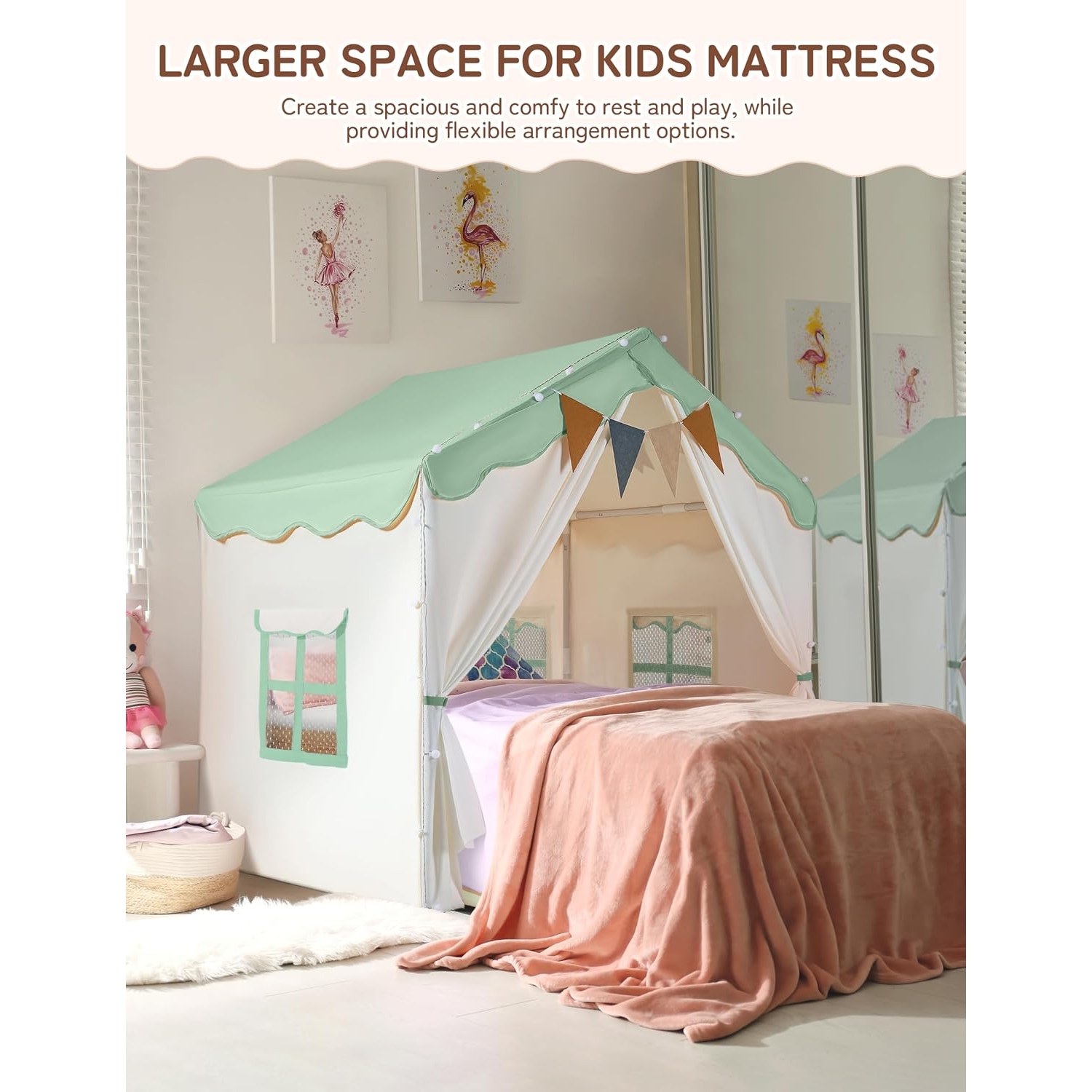
One more consideration. If you are thinking of it as a bedroom reading nook tent set alongside the bed, make sure the child can still get in and out of bed easily. The big door opening is designed to allow that kind of arrangement, but only if you leave the path clear.
For smaller homes, remember it breaks down. The cover lifts off, the poles separate, and the whole lot packs flat enough to go under a bed. A tent that disappears when guests come is a tent you can justify owning.
Age, siblings and how long it will last
The maker suggests 36 months to eight years. That is a wide band, and children use it differently across it.
Three and four year olds treat it as a house. They move toys in, serve imaginary meals and come out to announce things. Five to six is the imaginative peak, where it becomes a castle, a cave, a shop or a hospital depending on the week. Seven and eight year olds often shift it towards a private spot, somewhere to read, draw or just not be talked to for twenty minutes. All three are good uses.
With siblings, the width earns its keep. A 130 cm span fits a couple of children side by side without constant elbowing, and the second door gives them separate territory. Keep an eye on the poles if it gets heavy daily use, and re-seat any joint that works loose.
Supervise younger children, as you would with any fabric structure. Keep cords and small parts out, and do not let children climb on the frame from outside. Fibreglass poles handle normal play but they are not a climbing frame.
Keeping it clean and keeping it standing
Care is straightforward. Wipe small marks with a damp cloth and mild soap. For anything bigger, take the cover off the frame and machine wash it cool, then let it air dry completely. Skip the tumble dryer, which can shrink panels and leave the cover too tight to fit back over the poles.
Wipe the poles dry and check the joints for grit before you rebuild. If it has been outside, brush off any grass or soil first. Store it somewhere dry, since a damp cover left packed away will smell by the time you next want it.
If it lives near a window, turn it occasionally. Strong sunlight fades coloured fabric on one side over months, and rotating it evens that out.
The short version
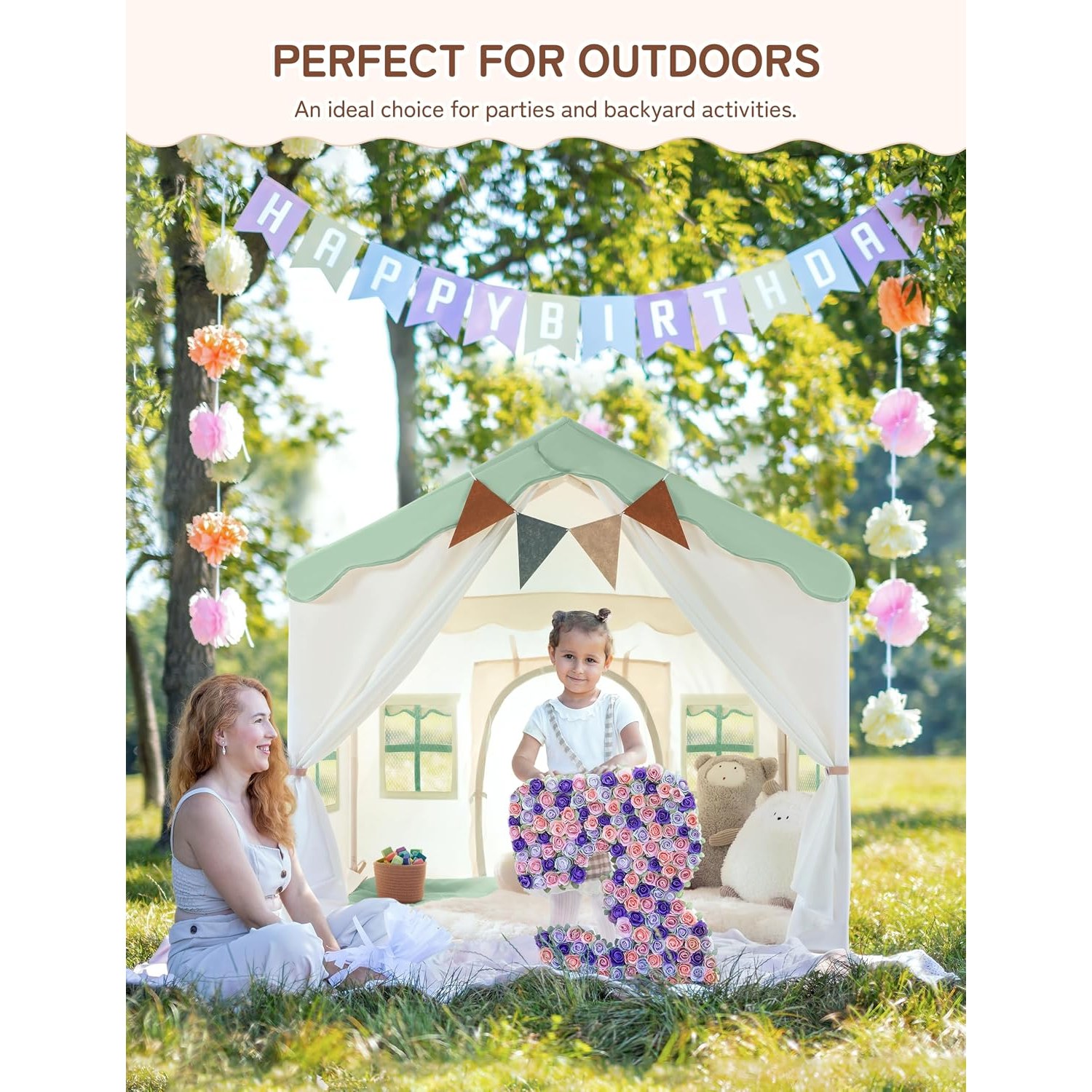
This is a 130 x 90 x 130 cm polyester play tent on a fibreglass frame, in green, with two doors, four windows, a padded mat and bunting. It weighs 3.69 kg, needs no tools to build, and the cover goes in the machine. The suggested age range is 36 months to eight years.
Measure your space first, press every pole fully home when you build it, and it will go up in minutes. The two-door layout is the feature that makes it work better than a single-entrance play tent, especially where more than one child is involved. Beyond that, it does the simple thing children want most, which is to give them a room of their own.